
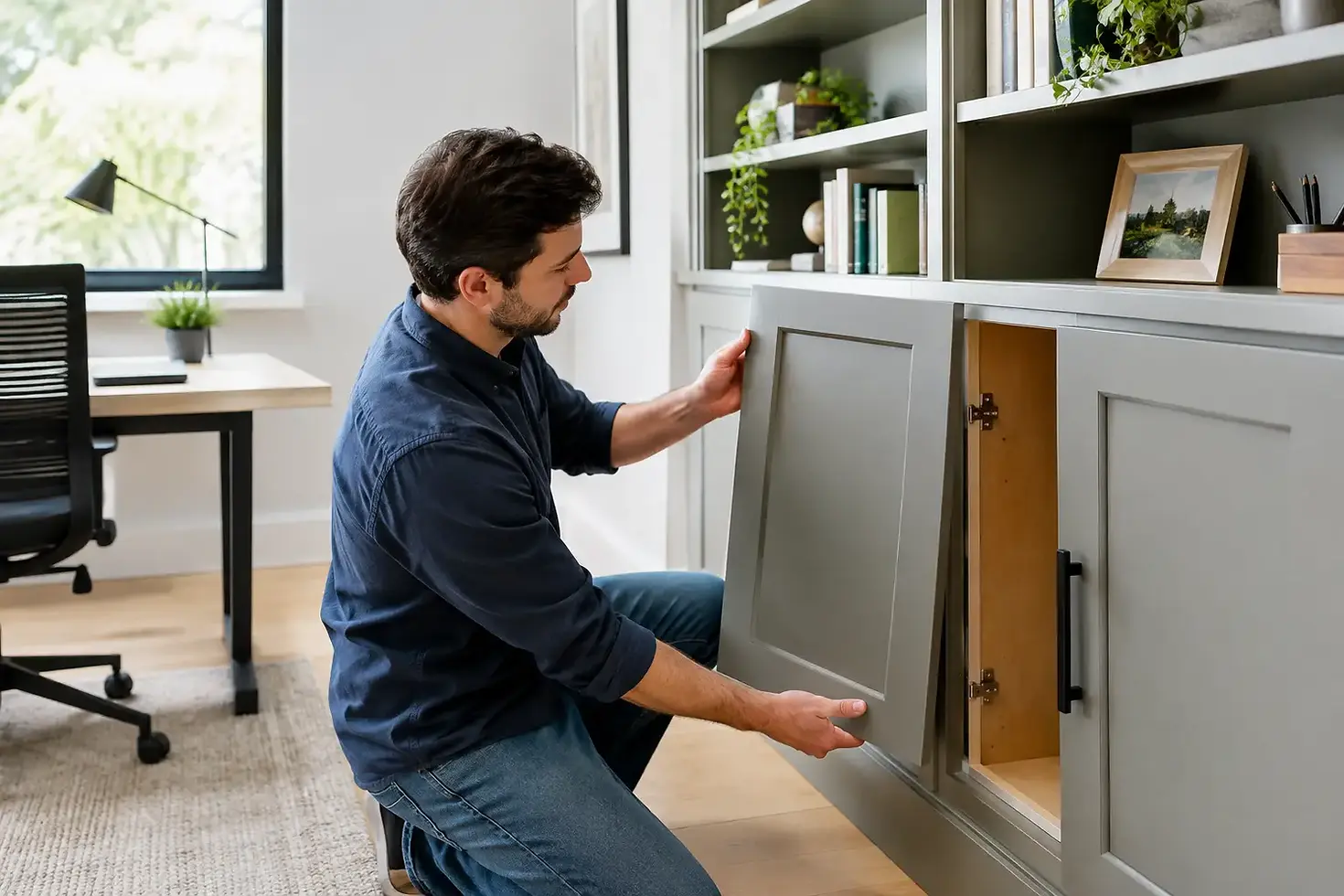
Home Office Cabinet Door Replacement Guide
A home office can feel dated long before the cabinet units themselves need replacing. Worn finishes, mismatched doors and heavy old-fashioned handles can make fitted storage look tired, even when the cabinet carcasses are still serving their purpose. Home office cabinet door replacement offers a practical way to change that look while retaining sound existing units.
For homeowners working from a spare room, study or converted bedroom, this approach can mean less disruption than removing and replacing a complete fitted office. It can also give you more control over the finished look, from door style and colour through to drawer fronts, panels, hinges and handles.
Is home office cabinet door replacement the right approach?
Replacing doors is most suitable where the existing cabinets are structurally sound, securely fixed and still work for the room. The carcasses need to be in reasonable condition, with no obvious damage that would affect how new fronts sit or operate. Photos are useful when seeking an initial guide price, but they cannot confirm every detail of the existing furniture.
The layout matters too. If your office storage already provides the right mix of cupboards, drawers and shelving, new made-to-measure fronts can refresh it without changing how the room functions. This is often useful in smaller rooms where fitted furniture makes the best use of awkward walls, alcoves or sloping ceilings.
It may be worth considering a wider redesign if the storage arrangement no longer suits your work. For example, a cabinet intended for files may be too shallow for the equipment you now use, or a desk-height run may need changing. Replacement doors improve the appearance of fitted units, but they do not alter the depth, internal layout or position of the existing cabinets.
Start with the existing cabinet layout
Before choosing a style, look closely at what is already in the room. Note each door, drawer front, end panel, filler panel and visible side. A home office often includes details that are easy to overlook, such as a desk return, a tall cupboard beside a window, or an open shelf sitting between two door sections.
Think about what you want to retain and what you want to change. You may only need replacement cabinet doors and new handles. In other rooms, matching drawer fronts, end panels, plinths and trims can make the update look more considered, especially where the sides of units are visible from the doorway.
It also helps to consider practical use. Doors that open into a narrow walkway, handles that catch on a chair, and low cupboards beneath a desk all influence the best choice of front and hardware. A simple, flat-fronted door may suit a compact contemporary workspace, while a more detailed style can work well where the home office is part of a traditional bedroom or living area.
Choose a look that works beyond the desk
A home office is often one of the most visible working rooms in the house. If it doubles as a guest room, sits off a hallway or is open to another space, the cabinetry should feel connected to the rest of the interior rather than purely functional.
Colour can change the mood quickly. Lighter finishes can help a compact room feel less enclosed, particularly when tall cabinets take up much of one wall. Deeper tones can give storage a more furniture-like appearance and may suit a room with plenty of natural light. The right choice depends on the room, its lighting and the finish of nearby flooring, walls and furniture.
Door style is equally important. Shaker-style fronts can add structure without being overly formal. Simpler slab doors tend to give a cleaner, quieter appearance. Handle choice has a surprisingly large effect: a small change in shape, finish or position can make an existing cabinet run feel more current. It is sensible to decide on handles early, as their fixing positions need to suit the selected fronts.
Avoid choosing every element in isolation. A door colour that looks appealing on its own may feel different beside your desk, carpet or wall paint. Looking at the room as a whole usually leads to a more settled result.
Accurate measurements make the order workable
Made-to-measure replacement doors are specified to the dimensions and details of your existing units. Accuracy is therefore central to the process. Alongside height and width, the required information may include door handing, hinge positions, drilling requirements, the number of doors and drawers, and whether panels or trims are needed.
Measure each front individually rather than assuming that matching-looking doors are identical. In older fitted furniture, small differences are common. It is also worth checking whether doors sit over the cabinet edges or within the opening, as this affects the required size and the finished gaps between fronts.
Easy DIY Doors begins with photos to provide a free guide price based on the visible scope. This gives you a useful starting point before finalising the specification. Once you have chosen the preferred range, style and colour, the next step is to confirm the measurements and quantities.
Professional Home Survey or self-measuring
Within the designated Professional Home Survey area across the Midlands, a survey can be used to verify the exact measurements, quantities and specification before manufacture. This is a measurement and specification service, not an installation service. It is designed to reduce uncertainty in a project where several doors, drawers, panels and fitting details need to work together.
The survey checks the scope against the original guide price. If the surveyed scope and quantities materially match that original quoted scope, the quoted price remains unchanged. If the scope differs, such as additional components being required or quantities changing, the order can be reviewed on the correct specification before it proceeds.
Customers outside the survey area can still order using the self-measuring option. In that case, customer-supplied measurements are the customer’s responsibility, so it is sensible to take time, record each item clearly and check the information before placing a supply order. If you plan to use a fitter or joiner, you are free to ask them to review your measurements and specification before ordering.
Do not forget the finishing components
A door-only change can make a significant difference, but the surrounding details determine whether the room looks fully refreshed. Exposed cabinet ends, gaps beside a run of cupboards, worn plinths and outdated handles can draw attention away from the new fronts.
Panels, trims and plinths can be specified where they are needed to complete the visible areas of fitted furniture. Hinges may also need consideration, particularly if existing hardware is worn or does not suit the new doors. The required components depend on the existing cabinets and the planned door arrangement, so it is better to identify them early than treat them as an afterthought.
This is also the point to consider any alterations your chosen tradesperson may need to make to the room itself, such as removing old fronts or adjusting surrounding decor. Easy DIY Doors supplies the made-to-measure doors and associated components; customers arrange fitting independently with a tradesperson of their choice if fitting is required.
Plan the project in a clear order
The simplest projects are usually the ones where decisions are made in the right sequence. Begin with clear photos of the current office cabinetry and request a guide price. Then settle on the overall style, colour and visible components rather than selecting doors alone.
Next, confirm the full specification through a Professional Home Survey where available, or through careful self-measurement. Once the sizes, quantities and details are agreed, you can place the supply order for delivery and make arrangements with your own fitter if you are using one.
Allow time for the room around the cabinets as well. New fronts can make tired paintwork, damaged flooring or cluttered open shelving more noticeable. You do not need to redecorate the entire room, but a planned refresh of the immediate area can help the finished office feel intentional.
A more measured way to update fitted storage
Replacing cabinet doors is not the answer to every home office problem. If units are damaged, poorly positioned or unable to meet your storage needs, retaining them may not be the right choice. But where the cabinet carcasses are sound and the layout still works, made-to-measure replacement fronts provide a controlled way to update the room without automatically replacing every part of it.
Start with what is already useful, be precise about the details that are visible, and give measurements the attention they deserve. That approach makes it easier to turn a tired fitted office into a space that feels more suitable for the way you work now.


Comments